· Case Studies · 11 min read
McDonald's Franchise and Real Estate Business Model
How the McDonald's franchise model works: rent vs. royalties, who owns the property, what franchisees pay, and why McDonald's is a real estate company too.
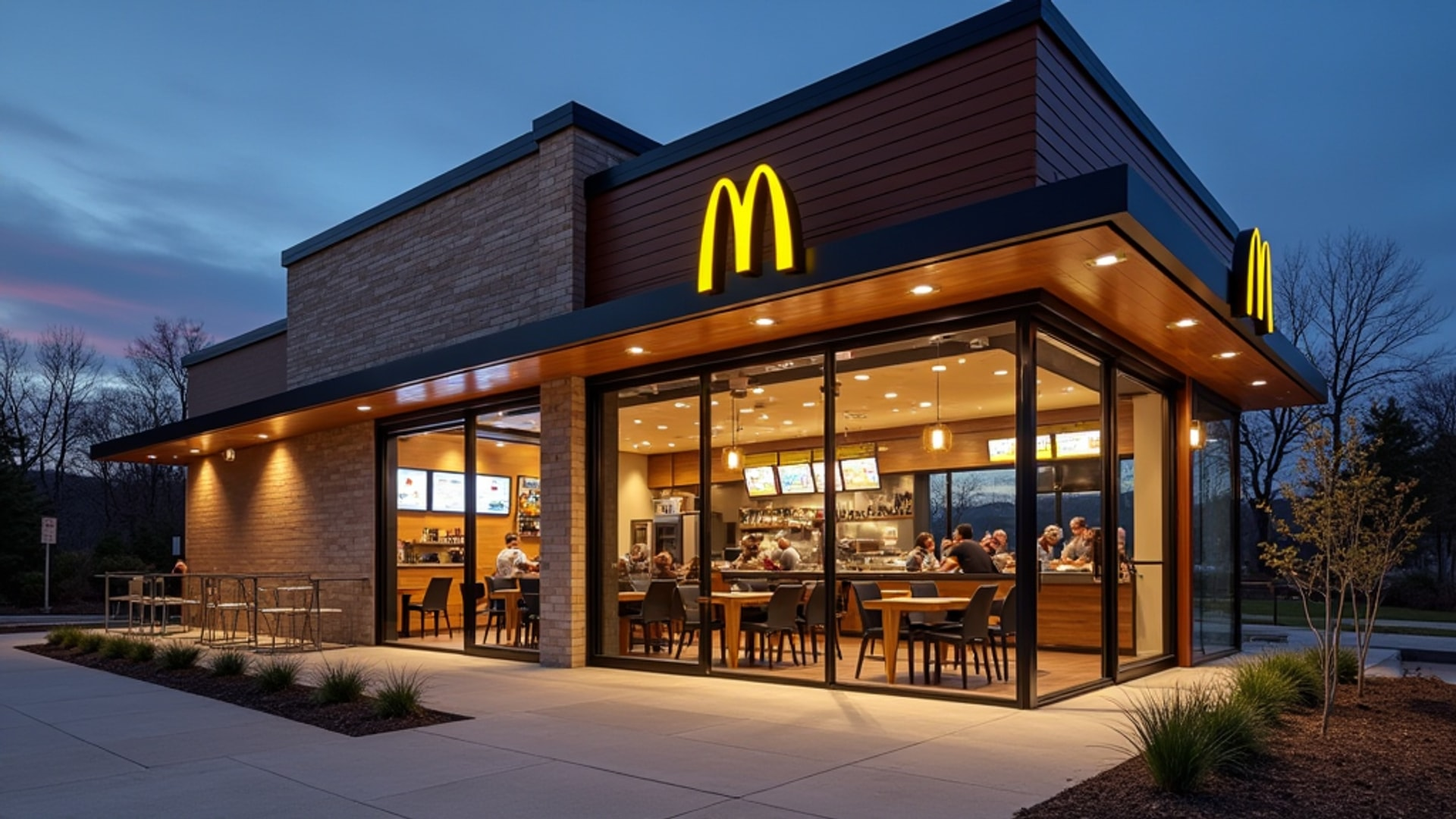
Ask most people what business McDonald’s is in, and they’ll say hamburgers. That answer is wrong in a way that costs restaurant operators real money, because if you misread how the most successful food service company in history makes its profit, you’ll misread every lesson it has to teach.
McDonald’s is, at its core, a real estate and franchise management operation. The hamburgers are the vehicle. The real product is the system.
McDonald’s Business Model at a Glance
McDonald’s makes most of its money from franchisees, not from selling food. In 2025, 62% of its $26.9 billion in revenue came from franchised restaurants, and the single largest line was rent: $10.4 billion, more than the $6.0 billion it collected in royalties. Company-operated restaurants brought in 36% of revenue but only a small share of the profit.
| Revenue stream, 2025 | $ millions | Share of total revenue |
|---|---|---|
| Rent from franchised restaurants | 10,442 | 38.8% |
| Royalties from franchised restaurants | 6,018 | 22.4% |
| Initial franchise fees | 88 | 0.3% |
| Sales by company-operated restaurants | 9,690 | 36.0% |
| Other revenues (technology fees, brand licensing) | 647 | 2.4% |
| Total revenues | 26,885 | 100% |
| Key figure, year-end 2025 | Value |
|---|---|
| Restaurants worldwide | 45,356 in more than 100 countries |
| Share franchised | About 95% (43,317 restaurants) |
| Company-operated restaurants | 2,039 |
| Operating income | $12.4 billion, a 46% operating margin |
| Franchised margins vs. company-operated margins | $13.9 billion vs. $1.4 billion |
| Real estate in consolidated markets | Owns about 56% of the land and 80% of the buildings |
| Sales at franchised restaurants (not McDonald’s revenue) | $129.7 billion |
All figures are from McDonald’s 2025 annual report on Form 10-K. The two margin numbers tell the story: franchised restaurants produced about 91% of McDonald’s restaurant margins, even though the company books the full sales of only the 2,039 restaurants it runs itself.
The Numbers That Tell the True Story
ArthNova’s analysis of the business model makes the point that changes everything: about 95% of McDonald’s restaurants are run by franchisees, not by the corporation.
A typical US franchised McDonald’s sells about $4 million a year. McDonald’s 2026 franchise disclosure document (FDD) reports average 2025 sales of $4,057,000 for franchised traditional restaurants open at least a year, with a median of $3,887,000 (Franchise Chatter’s FDD summary). The FDD’s own pro forma shows a restaurant with $3.4 million in sales earning $864,000, or 25.4%, in operating income before occupancy costs such as rent. The owner’s actual profit is well below that once rent, fees, financing and depreciation come out.
McDonald’s corporate, meanwhile, earned a 46% operating margin in 2025. That’s not a restaurant margin. That’s a real estate and financial services margin. The gap between franchisee economics and corporate economics is the entire story.
Is McDonald’s a Real Estate Company?
Partly, and more than most people realize. McDonald’s is a restaurant franchisor whose largest single revenue line is rent: franchisees paid it $10.4 billion in 2025, about 39% of total revenue and well above the $6.0 billion in royalties. It owns about 56% of the land and 80% of the buildings under its restaurants in its consolidated markets and holds long-term leases on most of the rest, then charges franchisees rent on top.
It is not a pure landlord, though. The rent is mostly a percentage of each restaurant’s sales, so McDonald’s property income rises and falls with how many burgers its franchisees sell. Think of it as a restaurant brand that captures the landlord’s share of its own success. Harry Sonneborn, one of the architects of the modern McDonald’s financial model, reportedly put it more bluntly: “We are not technically in the food business. We are in the real estate business.”
At the end of 2025, net property and equipment under franchise arrangements totaled $22.8 billion, including $7.1 billion of land. Future minimum rent payments already contracted from conventional franchisees came to $31.5 billion, split roughly evenly between sites McDonald’s owns and sites it leases and sublets.
How Does the McDonald’s Franchise Model Work?
A conventional McDonald’s franchisee runs the restaurant and pays for the equipment, signs, seating and décor, while McDonald’s controls the land and building. The franchisee then pays McDonald’s three things: rent and a royalty, both based on a percent of monthly sales, plus an initial fee when the restaurant opens or the franchise is granted. Agreements generally run 20 years.
According to University of Michigan Ross’ research on franchise versus independent business models, the financial structure of a franchise determines long-term profitability as much as the operating model does. McDonald’s structure produces two powerful revenue streams from every conventional franchised restaurant:
Royalties. Franchisees pay a royalty of 4% of monthly gross sales, or 5% for new US and Canadian franchisees, new builds and relocations since January 1, 2024, the first increase in about three decades (1851 Franchise). They also contribute at least 4% of sales to advertising.
Rent. Franchisees pay rent to McDonald’s for the physical location, set as a percentage of monthly sales with a minimum.
In the US, rent, royalties and initial fees together came to about 14% of franchised restaurants’ sales in 2025 ($7.4 billion of franchised revenues on $51.9 billion of franchised sales). McDonald’s collects that on top-line revenue regardless of how efficiently the franchisee runs the restaurant. The franchisee handles staffing, food quality, local marketing and service, and carries the operating risk.
Developmental licensees and affiliates, used in markets such as China and Japan, work differently: they provide the capital, including the real estate, and pay a royalty without rent.
Meanwhile, the real estate itself appreciates. McDonald’s has spent decades acquiring prime, high-traffic sites around the world, and that portfolio generates returns that have nothing to do with the price of a Big Mac. That’s why the corporation’s operating margin is structural, built into the model rather than dependent on operational excellence in each restaurant.
Do McDonald’s Franchisees Own the Property?
Usually not. Under a conventional franchise, McDonald’s owns or holds a long-term lease on the land and building, and the franchisee owns the equipment, signs, seating and décor inside. The franchisee is a tenant of McDonald’s as well as a licensee of the brand, and the property stays with McDonald’s when the franchise ends or changes hands.
That arrangement is deliberate. McDonald’s says in its annual report that ownership of real estate, combined with franchisee co-investment, lets it achieve restaurant performance levels among the highest in the industry. It also gives McDonald’s control: a franchisee who doesn’t meet the standards can’t take the location with them.
What Property Requirements Does McDonald’s Have?
For traditional restaurants, McDonald’s picks the site, not the franchisee. The company looks for locations that offer convenience and long-term sales potential, analyzing traffic and walking patterns, census data and other local information, and builds to standardized prototypes to control development costs. Franchisees are expected to reinvest in their restaurants over time, and McDonald’s sometimes co-invests in modernizations.
How Much Rent Do McDonald’s Franchisees Pay?
Rent is a percentage of each restaurant’s monthly sales, with a minimum, and it varies widely by location. Across all conventional franchised restaurants, McDonald’s collected $10.4 billion in rent on $93.8 billion of sales in 2025, about 11% of sales. In the US, where most existing restaurants pay a 4% royalty, the 14% combined take implies average rent of roughly 10% of sales.
At the 2025 average of about $4.06 million in sales, 10% rent is roughly $400,000 a year, or about $34,000 a month. Treat that as an average, not a quote: the 2026 FDD reports effective 2025 rents for individual US restaurants ranging from 0% to more than 33% of sales, depending on how much McDonald’s invested in the land, site improvements and building. In the UK and Ireland, McDonald’s says the monthly rent for 80% of restaurants franchised during 2025 fell between 8% and 18% of net sales.
| What a US franchisee pays McDonald’s | Typical amount |
|---|---|
| Initial franchise fee | $45,000 per restaurant |
| Royalty (service fee) | 4% of monthly gross sales, 5% for new restaurants and new franchisees since 2024 |
| Rent | A percentage of monthly sales with a minimum; about 10% on average, varying by site |
| Advertising | At least 4% of gross sales |
The Franchisee Investment Structure
Becoming a McDonald’s franchisee takes real capital. The 2026 FDD puts the total initial investment for a new restaurant at $1,472,000 to $2,807,000. That covers equipment, signage, seating, décor, opening inventory and other startup costs, but not the land and building, which McDonald’s retains.
Franchisees also pay the $45,000 initial fee per location for a franchise term that generally runs 20 years. The fee is modest next to the ongoing rent and royalties, but at McDonald’s scale it is another revenue stream.
From McDonald’s side, franchisees provide the growth capital for the system and carry the risk of each restaurant’s performance. The corporation contributes brand equity, supply chain, marketing and, critically, real estate. That division of labor has funded tens of thousands of restaurants without McDonald’s financing each one on its own.
What Operational Consistency Actually Requires
The franchise model only works if every location delivers a consistent experience. A customer who has a bad meal at one franchised restaurant damages the brand every other franchisee is paying for. Consistency is a financial requirement, not just a quality preference.
McDonald’s enforces it through one of the most extensive training systems in the industry. Hamburger University runs learning centers around the world plus online resources, training company employees, franchisees and their staff, so standards hold across more than 100 countries. The program covers everything from food safety to service standards to equipment maintenance.
That investment protects the brand value behind the royalty and rent streams. Every dollar spent on training and standards protects income from more than 43,000 franchised restaurants.

Growth Strategy: The Road to 50,000 Restaurants
McDonald’s opened 2,276 restaurants and closed 396 in 2025, plans about 2,600 openings in 2026, and is targeting 50,000 restaurants worldwide by the end of 2027, which it calls the fastest period of unit growth in its history. At the corporate level, each new franchised restaurant adds a new rent and royalty stream. At the franchisee level, each one requires seven figures of investment.
The growth is largely self-funding from McDonald’s perspective. Franchisees provide the capital. McDonald’s provides the real estate (or lease), the brand and the system. The corporation’s exposure is mainly the cost of securing and developing sites before leasing them to franchisees.
Adding thousands of restaurants is more about growing the rent roll than growing restaurant revenue, which is why Wall Street values McDonald’s differently from most restaurant companies.
Lessons for Independent Operators
Most operators will never run a system at McDonald’s scale. But the lessons in the model transfer at every size.
Real estate matters more than most operators think. The most common way independent operators destroy long-term value is by operating in leased space they don’t control. When your landlord raises rent at renewal, years of brand building transfer to the landlord’s balance sheet. McDonald’s solved this by controlling the real estate from the start.
System consistency is a financial asset. Every McDonald’s location reinforces the brand value that makes the royalty stream possible, through rigorous standard operating procedures. Independent operators who keep quality consistent across several locations are building the same kind of brand equity; they just keep it in-house rather than renting it to franchisees.
The business you think you’re in may not be the one generating your profit. McDonald’s started out in the burger business; the durable profit turned out to be in the land under the restaurants. That clarity about where profit actually comes from is available to any operator willing to examine their own numbers.
Franchising shifts capital requirements, not strategic obligations. If you ever consider franchising your own concept, understand that you’re entering the brand management business, and possibly the real estate business too. Your franchisees’ success depends on the systems you build, not just the brand you sell them.


The Limits of the Model
McDonald’s model is not infinitely scalable or universally applicable. Controlling premium, high-traffic real estate gets harder as commercial property costs rise and retail, logistics and residential developers compete for the same sites.
The franchisee base needs careful management. When franchisees fail, McDonald’s loses rent and takes reputational risk. The company has faced tensions with franchisees over cost-sharing for equipment upgrades, marketing fund allocations and new operating requirements, and the 2024 royalty increase drew criticism from franchisee groups. Managing more than 43,000 franchised restaurants takes serious corporate resources for franchisee relations, compliance monitoring and dispute resolution.
And the model needs continuous reinvestment in the brand. The system spends billions a year on advertising to keep the brand worth what McDonald’s charges for it. If brand value erodes, so does franchisees’ willingness to pay those rates, and the financial model with it.
The Real Estate Company Lesson
What McDonald’s teaches restaurant operators isn’t how to make a better hamburger. It’s how to think about the structural drivers of profit in a food service business.
The company’s durability across recessions, pandemics and competitive disruption comes from the recurring nature of rent and royalty income. That income doesn’t disappear when one location has a bad quarter. It scales with top-line sales rather than with operating efficiency, and it compounds as the property portfolio appreciates.
Understanding this structure won’t make your next restaurant a McDonald’s. But it will change how you think about your lease terms, your real estate options and, if you ever scale to multiple units, whether the business you’re building has the structural features that create lasting value or just the operational ones that create temporary cash flow.
The hamburgers are fine. The real product is the system.