· Kitchen · 13 min read
What Are Smallwares? Definition, Examples and Checklist
Smallwares are the hand tools, cookware and containers a kitchen runs on. The definition, smallwares vs. equipment, and an essential checklist by category.

What Are Smallwares?
Smallwares are the small, portable and relatively inexpensive tools a restaurant uses every day: knives, cutting boards, pots and pans, sheet and hotel pans, hand utensils, measuring tools, scales, storage containers, and serving pieces such as plates, glassware and flatware. They aren’t installed, plumbed or wired in, and you replace them as they wear out. Ovens, ranges, refrigeration and dishwashers are equipment, not smallwares.
The IRS uses almost the same list. Rev. Proc. 2002-12, which gives restaurants and taverns a simpler way to deduct these purchases, groups smallwares into ten categories: glassware, flatware, dinnerware, pots and pans, table-top items, bar supplies, food preparation utensils and tools, storage supplies, service supplies, and small appliances that cost $500 or less each (The Tax Adviser). That last category is why a blender or an immersion circulator can count as a smallware while a combi oven never will.
Large equipment gets the attention: the combi oven, the walk-in cooler, the hood system. But the tools your cooks touch hundreds of times a shift are smallwares, and their quality shows up on every plate. A dull knife, a warped sheet pan and a scored cutting board all degrade the work, and eventually they become food safety problems.
Smallwares vs. Kitchen Equipment: What’s the Difference?
Smallwares are portable, hand-held and cheap enough to replace as they wear out; kitchen equipment is large, usually installed, powered or plumbed, and bought as a long-term asset. A bench scraper, measuring spoons and a digital portion scale are smallwares. A commercial oven and a walk-in cooler are equipment. Size, installation and cost per item are the three tests.
| Smallwares | Kitchen equipment | |
|---|---|---|
| Examples | Knives, cutting boards, bench scraper, measuring spoons, digital portion scale, ladles, tongs, whisks, hotel pans, sheet pans, food storage containers, thermometers | Ranges, ovens, fryers, griddles, refrigerators, walk-in coolers and freezers, dishwashers, hoods, ice machines, mixers, slicers |
| Size and mobility | Hand-held or portable; moves between stations | Large; usually fixed in place |
| Utilities | None, or a plug-in small appliance | Gas, plumbing, dedicated electrical or ventilation |
| Cost per item | Low, from a few dollars to a few hundred | Hundreds to tens of thousands of dollars |
| Life span | Months to a few years; replaced on condition | Years to decades; repaired and maintained |
| How you buy it | Bulk orders from a smallwares supplier, topped up through the year | Specified, quoted, delivered and installed |
| Tax treatment | Often deductible when placed in use | Usually capitalized and depreciated |
Which of These Are Smallwares?
Of the five items most often listed together, three are smallwares and two are equipment. A bench scraper, a digital scale and measuring spoons are smallwares: portable, hand-held and cheap to replace. A commercial oven and a walk-in cooler are equipment: installed, powered and expensive.
| Item | Smallware or equipment? | Why |
|---|---|---|
| Bench scraper | Smallware | Hand tool for dough and prep |
| Digital scale | Smallware | Portable portion scale; a floor or receiving scale is equipment |
| Commercial oven | Equipment | Installed, gas or electric, often under the hood |
| Measuring spoons | Smallware | Hand-held measuring tool |
| Walk-in cooler | Equipment | Built-in refrigeration with its own compressor |
Regulators use different words for the same split. The FDA Food Code calls food-contact tools and containers “utensils” (kitchenware and tableware, plus food thermometer probes) and calls freezers, ovens, sinks, slicers and warewashing machines “equipment.” If an inspector writes you up on a utensil, they mean a smallware.
Essential Smallwares Checklist by Category
Use this as the opening list and adjust quantities to your menu and station count. Buy for peak service, not an average Tuesday: every station, every cook, plus spares cycling through the dish pit.
| Category | Essentials |
|---|---|
| Prep | Chef’s knives, paring knives, serrated knives, boning knife, sharpening steel, color-coded cutting boards, bench scrapers, peelers, mandoline, box grater, colanders, stainless mixing bowls, salad spinner |
| Cooking | Stockpots, saucepans, sauté pans, cast-iron and nonstick skillets, sheet pans, roasting pans, braziers, spiders and skimmers, tongs, solid, slotted and offset spatulas, kitchen spoons, whisks, sizzle platters |
| Measuring and portioning | Digital scale (1-gram accuracy), liquid and dry measuring cups, measuring spoons, portion scoops and dishers, ladles in set sizes, portion-control spoons |
| Storage | Hotel pans (full to sixth size) with lids, food storage containers with lids, ingredient bins, sheet pan rack covers, squeeze bottles, deli containers, date labels |
| Food safety | Probe thermometers, including a thin-probe model for patties and fillets; refrigerator and freezer thermometers; sanitizer buckets and test strips; first-in, first-out labels |
| Serving and front of house | Plates and bowls, glassware, flatware, serving platters, ramekins, bread baskets, bar tools (jiggers, shakers, strainers, bar spoons), pitchers, check presenters |
The food-safety row isn’t optional. The Food Code requires food thermometers to be provided and readily accessible, including one with a small-diameter probe for thin foods such as meat patties and fish fillets, and Fahrenheit-only thermometers must be accurate to ±2°F.
Which Smallwares Are Necessary for Efficient Food Prep?
The core prep set is a sharp chef’s knife and paring knife per cook, color-coded cutting boards, a digital scale, measuring cups and spoons, portion scoops and ladles, stainless mixing bowls, hotel pans and sheet pans, a bench scraper, peelers, and labeled storage containers. Those items set the pace of prep: if cooks wait for a clean board or borrow a scale from the next station, your prep system is short of smallwares, not short of time.
Efficiency comes from duplication and standard sizes. Every station gets its own core set, so nothing walks. Ladles and scoops come in the exact portion sizes your recipes call for. Containers and hotel pans are standard sizes, so they stack, fit the line and label consistently.
The NSF Certification Standard
Look for the NSF mark before you buy anything that touches food. NSF (originally the National Sanitation Foundation) certifies that a product meets public health standards for materials, design and cleanability. NSF is one of the ANSI-accredited certifiers, and the Food Code treats food equipment certified to an American National Standard by such a program as compliant with its design and construction requirements. That is why many inspectors look for the mark. Certified items are built to:
- Withstand commercial conditions: heat, chemicals and repeated use
- Clean and sanitize easily
- Avoid cracks, crevices and unsealed joints where bacteria hide
- Meet the Food Code’s rule that food-contact surfaces be smooth and free of breaks, open seams, cracks, chips and pits
Consumer-grade tools can look the same and cost less, but they aren’t built for the cycle of use, washing and sanitizing in a commercial kitchen. Plastics break down, handles come loose, and surfaces crack. The price difference is often modest; the durability difference over a year of service is not.
Knives: The Foundation of Every Prep Station
A professional knife set is a cook’s most important toolset, and every station needs three:
- Chef’s knife (8 to 10 inches): chopping, dicing, mincing and slicing. Look for a full tang, a comfortable grip, and high-carbon stainless steel that holds an edge through heavy use.
- Paring knife (3 to 4 inches): peeling, trimming, deveining and detail cuts the larger blade can’t do cleanly.
- Serrated knife (8 to 10 inches): bread, tomatoes and anything with a tough outside and soft inside.
Common additions are a boning knife for butchery, a fillet knife for fish and a carving knife for plated proteins.
Maintenance matters as much as selection. A dull knife needs more force per cut, and more force means less control and more injuries (ChefEquipment.com). Hone on a steel before each shift and send knives for professional sharpening every few weeks, more often in high-volume prep.
Store knives on magnetic strips, where they stay visible and dry. Blocks are acceptable but harbor bacteria if knives go in wet. Rolls are for carrying, not station storage. Never keep knives loose in a drawer.
Color-Coded Cutting Boards
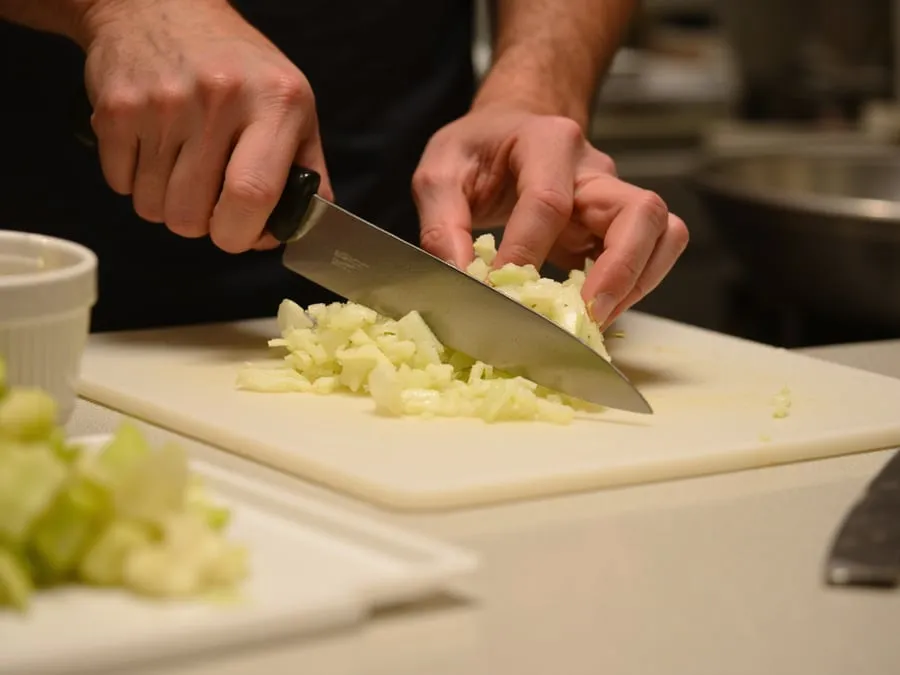
Color-coding cutting boards is one of the cheapest cross-contamination controls a kitchen can buy. It isn’t a Food Code requirement, but it is standard practice in professional kitchens and a common control in HACCP plans, because a board used for the wrong product is obvious at a glance (cross-contamination prevention).
The most common system:
| Color | Designated use |
|---|---|
| Red | Raw beef and red meat |
| Yellow | Raw poultry |
| Blue | Raw seafood and fish |
| Green | Fresh produce |
| White | Dairy and bakery |
| Brown or tan | Cooked meats and ready-to-eat items |
Give each station the boards its work needs and never share boards between categories. Post the code at every station and teach it in onboarding.
Most commercial boards are NSF-certified polyethylene because it survives the dishwasher. Wood is allowed: the Food Code permits hard maple or an equally hard, close-grained wood for cutting boards, but wood needs hand-washing and oiling, so few high-volume kitchens use it on the line. Whatever the material, the rule is the same. Boards that are scratched and scored so they can no longer be cleaned and sanitized must be resurfaced or discarded.

Cookware

Stockpots
Stockpots handle stocks, soups and batch pasta without scorching. Commercial stockpots range from 12 to 60 quarts, sized to your menu. Heavy-gauge stainless steel or aluminum prevents the hot spots that cause sticking. Any station cooking soups, stocks or pasta needs at least two: one in use, one in rotation.
Sauté Pans
Wide and flat-bottomed with sloped sides, sauté pans cover searing, stir-frying, tossing vegetables and finishing proteins. Commercial sizes run 8 to 14 inches in heavy-gauge stainless or carbon steel. The sloped sides let cooks toss without spilling and plate quickly.
Saucepans
Smaller and deeper than sauté pans, with straight sides for sauces, reductions and small portions. A hot line usually needs several sizes: 1 to 2 quarts for individual sauces and 4 to 6 quarts for batch sauces held through service.

Sheet Pans
The workhorse of the kitchen. Full sheet pans (18 x 26 inches) and half sheets (13 x 18 inches) handle roasting, baking, holding prepped ingredients, chilling and carrying. Plan on 6 to 10 sheet pans per major cooking function as a minimum, and many more for roasting and baking. Buy heavy-gauge aluminum; thin pans warp at high oven temperatures and are useless within weeks.
Cast-Iron and Nonstick Skillets
Cast iron holds heat for searing and moves from stovetop to oven. It heats slowly but keeps its temperature through several portions, which is why it is the pan of choice when crust consistency matters. Seasoned and cared for, it lasts a lifetime.
Nonstick pans are the opposite: cheap, light and short-lived in a busy kitchen. The Food Code requires nonstick cookware to be used with non-scratching utensils and cleaning aids, so stock silicone or nylon tools alongside them.
Daily-Use Utensils
These are the items every station uses every shift:
- Ladles in 2, 4, 6 and 8 ounces for soups, sauces and portioning. Consistent sizes are a portion control tool, so use the same size for the same job across the kitchen.
- Tongs in 9 and 12 inches, commercial stainless. Replace them when the spring weakens or the tips lose grip.
- Spatulas: solid for flipping, slotted for draining, offset for plating and spreading. At least two of each per station.
- Whisks: ball whisks for tight containers, balloon whisks for volume, flat whisks for sauces.
- Measuring cups and spoons: separate liquid cups (clear, with markings readable at eye level) and dry cups, and spoons from 1/8 teaspoon to a tablespoon at every station where recipe accuracy matters.
- Digital scales accurate to at least 1 gram. Weighing removes the inconsistency of measuring dense or irregular ingredients by volume.
- Mixing bowls in stainless steel, from 1.5 to 30 quarts. They don’t absorb odors, they stack, and they handle boiling water and ice baths that some plastics can’t.
Storage and Organization Tools
Food Storage Containers
Clear polycarbonate containers in standard sizes from 2 to 22 quarts, with matching lids, are the industry standard. Cambro is the best-known brand and NSF-certified equivalents exist from other makers. Standard sizes stack efficiently, keep the cooler organized and make uniform labeling easy. WebstaurantStore has useful guidance on organizing storage within different kitchen layouts.
Colored lids or containers let you separate allergen-containing items, raw proteins and ready-to-eat foods at a glance.
Hotel Pans (Steam Table Pans)
Hotel pans in full (12 x 20 inches), half, third, quarter and sixth sizes are the universal container of the professional kitchen. They fit steam tables, refrigerators, racks, holding equipment and serving lines, and the dimensions are standard across manufacturers. A commercial kitchen should stock at least 12 to 20 full-size pans and proportional numbers of smaller sizes.
Squeeze Bottles
For sauces, oils and precise plating. Squeeze bottles give better portion control than pouring. Buy commercial-grade bottles in several sizes and label each with contents and fill date.
How Much Should You Budget for Smallwares?
There is no reliable industry benchmark for smallwares as a share of opening costs, and generic estimates vary too widely to plan with. Build the budget bottom-up instead: list each station, the smallwares it needs at peak, a par level for spares, and current prices from two suppliers. NAFEM publishes ordering guidelines by facility type that help with quantities.
A starting framework for a 50-cover full-service restaurant:
- 12 to 15 chef’s knives across prep and line stations
- 8 to 10 paring knives
- At least 6 boards per color in the cutting board system
- 30 to 50 sheet pans
- 20 to 30 hotel pans per size across the system
- 15 to 20 pairs of tongs
- 30 to 40 food storage containers in various sizes
Scale up with covers and down for limited menus. Size front-of-house tableware the same way: enough plates, glassware and flatware that the dish pit never runs you out mid-service.
On the tax side, the IRS lets businesses deduct items costing up to $2,500 per invoice or item under the de minimis safe harbor if they don’t have an applicable financial statement (IRS), and Rev. Proc. 2002-12 lets restaurants deduct smallwares when they are received and available for use. Smallwares bought before you open may be treated as start-up costs instead. The rules interact, so have your tax preparer set the method in your first year (restaurant tax planning).
How Often Should You Replace Smallwares?
Replace smallwares on condition, not on a calendar. The Food Code requires utensils to be kept in good repair or discarded, cutting boards that can no longer be cleaned and sanitized to be resurfaced or thrown out, and food thermometers to be calibrated as the manufacturer specifies. In practice that means checking high-wear items weekly and budgeting replacement as an operating expense, not a one-time opening cost.
| Item | Replace or service when |
|---|---|
| Cutting boards | Scoring is deep enough that the board no longer cleans and sanitizes; resurface or discard |
| Knives | Sharpen every few weeks; replace when chipped, bent or the handle loosens |
| Nonstick pans | The coating is scratched, flaking or no longer releases |
| Sheet pans | Warped so they rock in the oven or won’t slide into racks |
| Tongs | The spring weakens or the tips no longer grip |
| Food storage containers | Cracked, crazed or scratched so the inside can’t be cleaned |
| Thermometers | Calibrate per the manufacturer (the ice-water check is quick); replace if they won’t hold calibration |
| Squeeze bottles and deli containers | Cloudy, stained or holding odors |
Track what you throw away. If tongs disappear faster than they wear out, you have a par-level or theft problem rather than a quality one (kitchen par levels).
Invest in quality for the items cooks use all shift, such as knives, pans and scales, buy enough that nobody runs short during service, and maintain them. Smallwares are what your team’s hands spend the most time with. They deserve more than an afterthought budget.