· Kitchen · 9 min read
Measuring Kitchen Productivity: Ticket Times, Labor Efficiency, and Speed of Service
Without the right metrics, kitchen management is guesswork — here are the key performance indicators that actually tell you how your kitchen is performing.

Managing a kitchen without metrics is like running a restaurant without a POS — you know roughly what is happening, but you are making critical decisions based on intuition rather than data. According to Foodie Coaches’ analysis of kitchen KPIs, without systematic measurement operators rely on gut feelings rather than data, making it difficult to identify bottlenecks, control costs, or reward high-performing staff. The most effective restaurants track a specific set of financial, operational, and service-quality metrics — and they track them consistently enough to catch problems before they compound.
This is not about measuring everything. It is about measuring the right things at the right frequency.
The Speed of Service Foundation
Speed of service is the total elapsed time from order placement to food delivery on the table. It encompasses the entire chain: greeting time, order-taking, kitchen preparation, quality check at the pass, and delivery to the guest. According to NetSuite’s analysis of restaurant speed of service, faster table turnover directly correlates with revenue per shift — which makes ticket time the metric most directly connected to your top line.
The baseline benchmark most kitchen operators use: appetizers at three minutes, entrees at seven minutes, from the moment the ticket fires in the kitchen. These are targets, not guarantees, but posting them in the kitchen creates accountability for every station. When actual times drift significantly above these targets, the data points to where the problem is rather than leaving management to speculate.
NetSuite identifies several key benchmarks from industry analysis:
- KDS implementation can improve order accuracy by 25 percent
- Ticket times improve by an average of five minutes with KDS compared to paper ticket systems
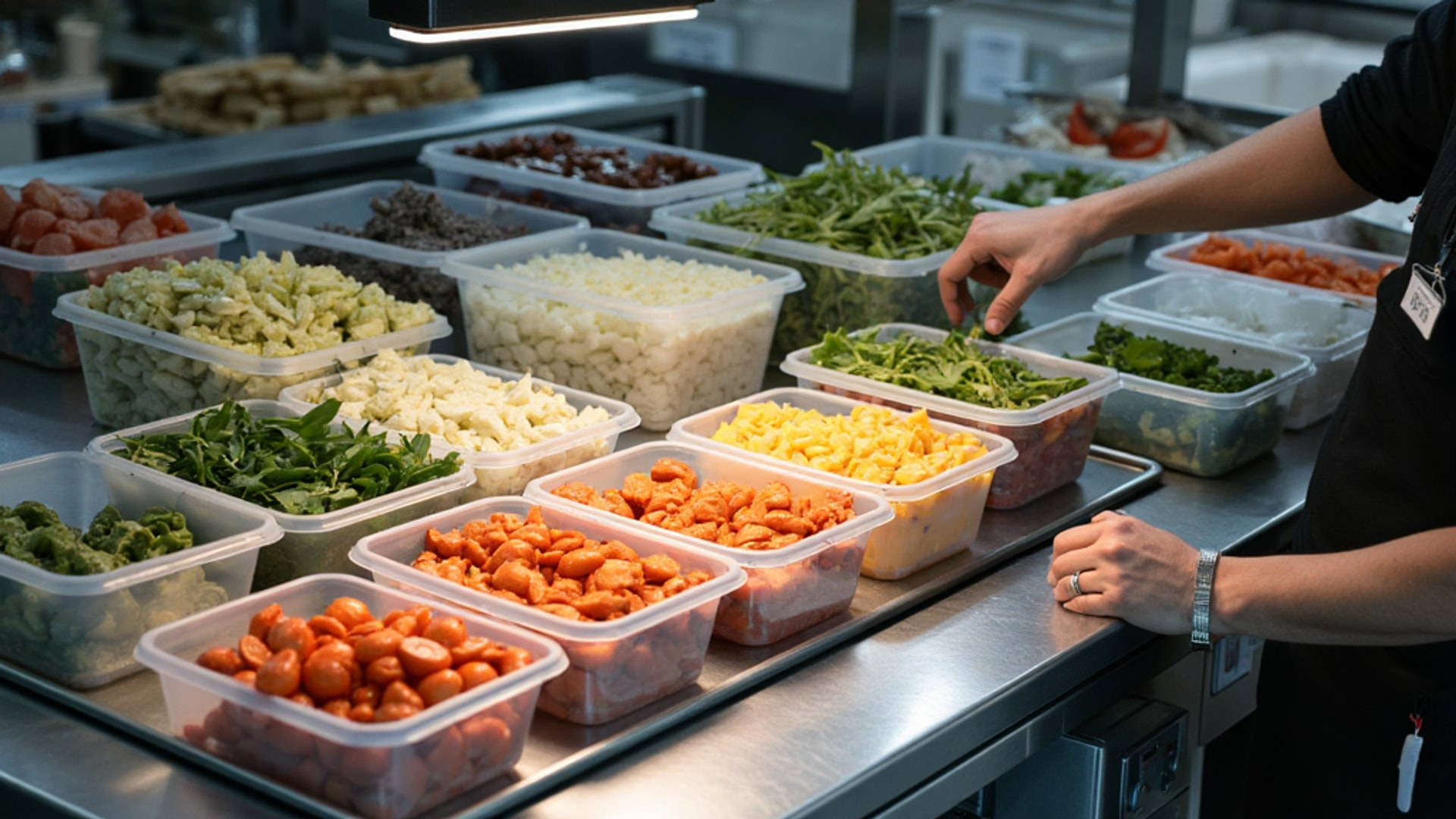
- Mise en place preparation before service can reduce ticket times by up to 50 percent
- Comprehensive optimization steps can reduce peak-period ticket times by up to 25 percent
That 50 percent reduction from proper mise en place is the most important number on the list. Kitchen productivity is as much a prep-time discipline as it is a service-time discipline.
Average Order Preparation Time
This is the most direct measure of kitchen efficiency. Calculate it by dividing total preparation time by total number of orders in a service period. A kitchen producing 180 orders in a service period with 1,260 total accumulated preparation minutes is averaging seven minutes per order.
Lower averages generally indicate a more productive kitchen, but Foodie Coaches correctly notes that this must be balanced against food quality standards. A kitchen averaging four minutes per order is impressive until you realize it is because cooks are pulling proteins off heat ten seconds before they are ready. Track preparation time alongside quality metrics — specifically re-fire rate and customer complaints — to get an accurate picture.
The preparation time metric is most useful when tracked by shift, day of week, and station. When Wednesday evening preparation times are consistently 40 percent higher than Tuesday evenings, that pattern reveals a specific operational problem (understaffing, prep gaps, menu specials that create bottlenecks) rather than a general kitchen performance issue.
Covers Per Labor Hour
Covers per labor hour is one of the most useful productivity metrics for kitchen operations. Calculate it by dividing total covers served by total labor hours worked in that period.
A kitchen producing 200 covers with 20 labor hours is running at ten covers per labor hour. A kitchen producing the same 200 covers with 30 labor hours is at 6.7 covers per labor hour. The difference is either a staffing efficiency problem or a throughput problem, and the ratio alone does not tell you which. But it gives you the number to investigate.
Foodie Coaches’ analysis shows covers per labor hour is particularly revealing when compared across shifts, service types, and staffing configurations. A brunch service that runs at four covers per labor hour while dinner service runs at nine reveals a fundamental imbalance — possibly too many staff on brunch, or a brunch menu that is execution-intensive relative to its cover count.
This metric motivates cross-training investment. A kitchen where every cook can effectively execute any station reaches higher covers-per-labor-hour ratios during partial-staff scenarios than a kitchen where each cook is confined to one station.
Plates Per Hour
Plates per hour quantifies raw kitchen throughput, which Foodie Coaches identifies as particularly important for quick-service and high-turnover concepts where margin depends on volume. Calculate it as total plates produced divided by total kitchen hours in service.
For a quick-service concept, this number can be tracked almost continuously during service. A sudden drop in plates per hour during what should be peak production time signals a problem: an equipment failure, a prep gap, a staffing issue, or a communication breakdown. Real-time tracking lets managers intervene quickly rather than discovering the problem at end-of-service reconciliation.
For full-service restaurants, plates per hour is more useful as a weekly or monthly trend indicator than an in-service monitoring tool. Tracking it across comparable service periods reveals whether kitchen throughput is improving, declining, or holding steady as menu changes and staffing adjustments are made.
Food Cost Percentage
Food cost percentage measures ingredient spending relative to revenue. The formula: food cost divided by food revenue, multiplied by 100. A kitchen spending $3,200 on ingredients in a week that generates $9,400 in food revenue is running a 34 percent food cost.
Industry benchmarks vary by restaurant type. Fine dining typically runs 28 to 35 percent food cost; casual dining 28 to 38 percent; quick service 25 to 35 percent. These ranges are guides, not absolutes — your specific model, menu, and sourcing structure determine what is optimal for your operation.
Foodie Coaches recommends reviewing food cost percentage weekly to catch drift before it compounds. Food cost creep is one of the most common kitchen productivity problems: it starts with small over-portions, minor waste increases, and inconsistent receiving practices, and by the time it shows up clearly in monthly reports it has already cost thousands of dollars.
Track food cost at the category level — proteins, produce, dairy, dry goods — not just as a single aggregate. When food cost increases by three percentage points in a month, knowing it is entirely concentrated in protein tells you something specific. Knowing it is spread evenly across all categories tells you something different.
Labor Cost Percentage
Labor cost as a percentage of revenue tracks the proportion of income consumed by staffing costs. For kitchen staff specifically, this measures how efficiently the kitchen converts labor investment into output.
Kitchen labor benchmarks typically target 25 to 35 percent of revenue, though this varies substantially by service model. A quick-service kitchen with lower labor costs per cover can operate at the lower end; a fine-dining kitchen with highly paid, specialized staff may operate toward the upper end.
Foodie Coaches identifies weekly labor cost review as the minimum frequency for catching problems before they become structural. The actionable insight from tracking this metric is not just whether it is high or low — it is whether it correlates with revenue changes or operational changes. When labor cost rises while revenue holds flat, either labor hours increased unnecessarily or revenue per cover decreased. When both fall simultaneously, that is a different problem.
Ticket Time Variance and Consistency
Foodie Coaches identifies ticket time variance as a key metric for flagging inconsistency. A kitchen that averages seven minutes per entree with a variance of plus or minus one minute is delivering predictable performance. A kitchen averaging seven minutes with variance of plus or minus four minutes is operating erratically — some tables get food in three minutes, others wait eleven.
Erratic ticket times damage the guest experience more than consistently slow ticket times in some contexts. Guests sitting near a table that received food quickly while their own order takes significantly longer perceive unfairness rather than just slowness. Consistency in service timing is a distinct quality metric from average speed.
Tracking variance requires KDS data. Paper ticket systems cannot reliably produce the granular time-stamping needed to calculate meaningful variance. This is one of the strongest operational arguments for KDS investment beyond its accuracy benefits.
Waste Tracking
Waste tracking measures both pre-consumer waste from preparation and post-consumer waste from returned plates. Foodie Coaches highlights this metric as one that identifies opportunities for portion adjustment and inventory management that directly improve food cost.
Pre-consumer waste — trim waste, over-production waste, spoilage — is the most actionable category. If vegetable trim waste is consistently high, it points to either excessive prep standards (trimming more than necessary) or poor purchasing (buying more than prep schedules require). If spoilage waste is high in specific categories, it indicates a purchasing frequency or storage management problem.
Post-consumer waste — food returned uneaten — signals a different set of issues: portion sizes that exceed guest appetite, menu items that do not meet expectations, or preparation failures. Tracking which menu items generate the most returns reveals quality consistency problems that service feedback alone might not surface clearly.
Technology and Tracking Infrastructure
Kitchen Display Systems are the foundation of operational data collection in a modern kitchen. As Foodie Coaches notes, KDS platforms provide real-time data on prep times, staff productivity, and order flow, replacing the guesswork of paper ticket rails. Modern KDS platforms generate dashboards showing historical trends alongside live performance, enabling managers to intervene before small problems become service failures.
Review cadence matters as much as which metrics you track. Foodie Coaches recommends reviewing food cost and waste weekly, labor cost weekly, and ticket time performance at least weekly with daily spot-checks during high-volume periods. Longer-cycle metrics like employee turnover and equipment downtime are tracked monthly or quarterly.
The management discipline that makes metrics useful is actually acting on what they show. A kitchen that meticulously tracks ticket times but does not use that data to adjust staffing, prep protocols, or station layouts is doing administrative work without operational benefit. The numbers are inputs to decisions, not outputs to file.
→ Read more: Kitchen Technology: KDS, IoT Monitoring, and Smart Energy Systems
→ Read more: Restaurant Operations KPI Dashboard: The Metrics That Actually Drive Decisions