· Operations · 16 min read
Building Your Restaurant Technology Stack: POS, KDS, Reservations, and Everything In Between
The restaurants winning today are not the ones with the most technology — they are the ones whose technology actually talks to each other.

A decade ago, a restaurant’s technology stack was a POS terminal and maybe a phone reservation system. Today, the average operation juggles a POS, online ordering, third-party delivery platforms, a reservation system, kitchen displays, inventory software, scheduling tools, loyalty programs, and an accounting integration. According to the National Restaurant Association’s 2024 Technology Landscape Report, 73% of operators increased technology investments in 2024 — the highest digital adoption rate in the sector’s history.
The problem is not a lack of technology. The problem is that most restaurants assembled their stack one tool at a time, each solving a narrow problem but creating data silos in the process. The result: managers re-entering data between systems, reports that do not reconcile, and an operations team that spends more time fighting software than running the restaurant. The POS system should be the foundation everything else integrates with.
The fix is building an integrated stack where every tool connects. According to FoodHub, the dominant technology trend is convergence — individual point solutions being replaced by unified platforms managing EPOS, online ordering, delivery, inventory, loyalty, and analytics in one place. The restaurants that build connected stacks gain advantages in both efficiency and data-driven decision making.
The Core Components
Every restaurant technology stack has the same building blocks, regardless of size or concept. The difference is how well they connect.
1. POS System: The Central Hub
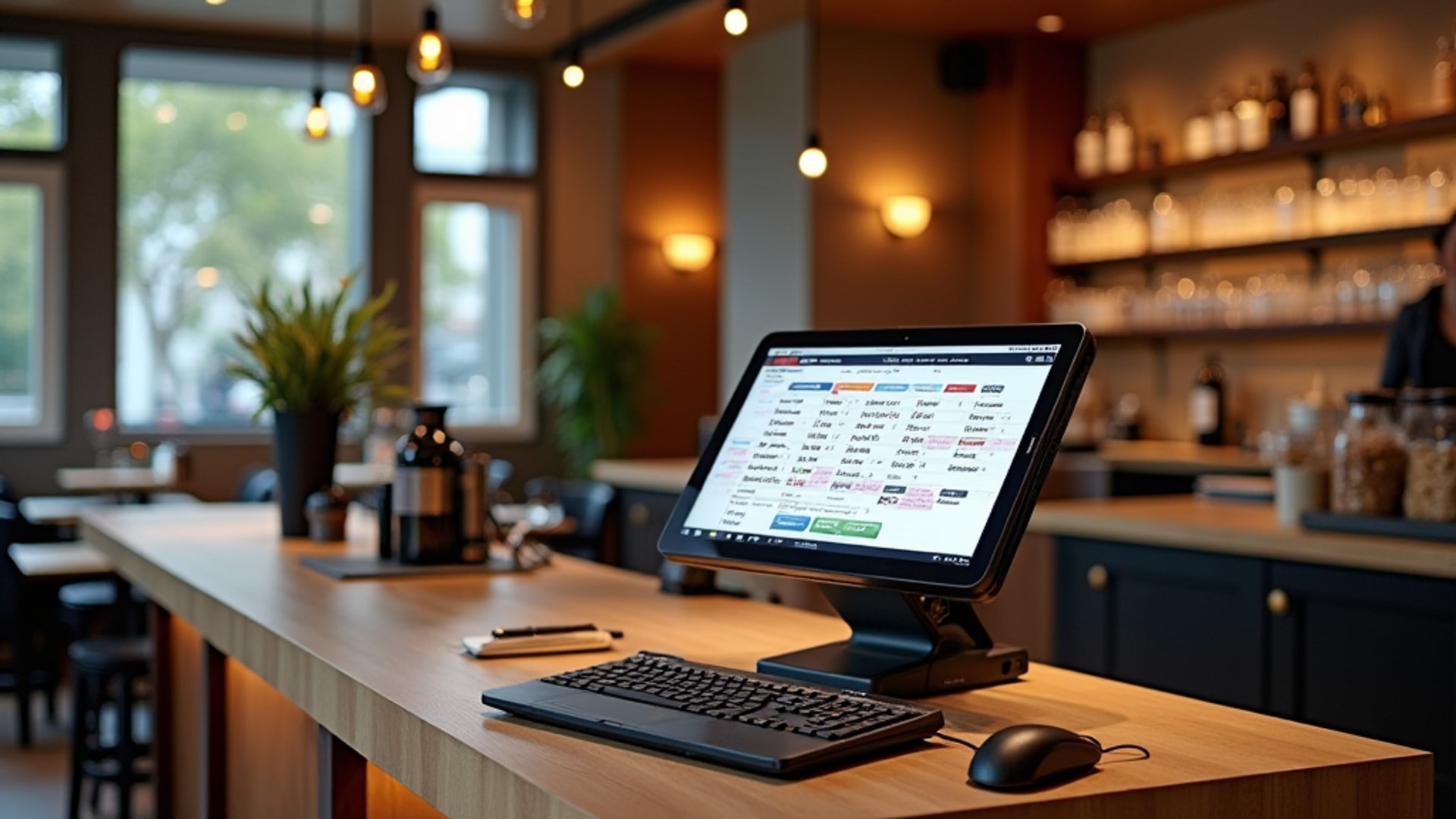
The POS is the foundation. Every other technology layer either feeds data into it or pulls data from it. According to Quantic POS, modern POS platforms function as comprehensive operational command centers connecting front-of-house service, kitchen operations, inventory management, and business analytics.
Four platforms dominate the market, each serving different segments. According to UpMenu’s 2025 comparison, Square serves small-to-medium restaurants and food trucks with a clean interface and generous free tier. Toast leads in full-service dining at $69 per month for software with hardware bundles from approximately $1,000. Lightspeed targets multi-location restaurants with centralized control. And according to Quantic POS, SkyTab differentiates with free hardware and a flat $29.99 monthly fee.
Cloud-based architecture has become the industry standard. According to FoodHub, cloud POS enables real-time sales access off-site, live menu updates across locations, centralized multi-branch control, and reduced maintenance needs. The cost comparison tells the story: according to industry data, legacy on-premise systems cost $50,000 to $60,000 with five-to-seven-year refresh cycles, while cloud platforms start free and scale from there.
Selection criteria: According to UpMenu, operators should evaluate scalability, ease of use for staff training, and integration capabilities with other tools — accounting, inventory, scheduling, online ordering. The POS you choose determines what else can connect, so this decision comes first.
According to YouTube reviews from Point of Sale USA, when choosing a POS, prioritize features aligned with your service model. Full-service restaurants need tableside ordering, course management, and split-bill capabilities. Quick-service operations need speed of transaction and kitchen display integration. Restaurants doing significant delivery volume need seamless integration with third-party platforms. All restaurants benefit from real-time sales reporting and inventory tracking.
2. Kitchen Display System (KDS)
The KDS replaces paper tickets with networked digital screens and creates a real-time command center for kitchen operations. According to Restaurant365, KDS implementation can reduce order fulfillment time by up to 40% and decrease food waste by up to 25%.
Here is how it works: when a server enters an order or a customer places an online order, it appears instantly on the appropriate kitchen display screen. According to Restaurant365, orders are automatically routed to the correct stations — grill, saute, fry, salad — and organized by priority based on order time, course sequence, and estimated preparation time. This intelligent routing eliminates the expediter’s task of manually sorting and distributing paper tickets.
The coordination benefit matters most for multi-component orders. According to Restaurant365, KDS systems time the preparation of different dishes within a single order so they finish simultaneously. Color-coded alerts indicate when tickets are approaching or exceeding target preparation times, prompting corrective action before delays reach the guest.
An often-underutilized capability is data capture. According to Restaurant365, the system automatically records preparation times by dish, station, time of day, and individual cook. This reveals which dishes take longer than expected, which stations become bottlenecks during peak periods, and how individual team members perform. That data drives better station assignments, targeted training, and recipe adjustments.
Implementation note: According to Restaurant365, start with the highest-impact station and expand systematically. Screen placement should consider kitchen traffic flow, staff visibility, and station proximity. Kitchen-grade hardware — resistant to heat, moisture, and grease — is essential. Do not cut costs on displays that will live in a hot, greasy environment. Consumer-grade screens fail quickly in kitchen conditions.
According to Barmetrix, KDS with intelligent order routing optimizes ticket flow by coordinating preparation times across stations so components of multi-item orders finish simultaneously. This is the kind of coordination that even an excellent expediter struggles to maintain consistently across a busy Friday night service.
3. Reservation and Table Management
The reservation layer connects your front-of-house to your guests before they walk in the door. According to YouTube extracts on reservation systems from DinnerBooking, the fundamental problem that reservation systems solve is a revenue leak most owners underestimate: during peak service, staff cannot answer the phone, and outside operating hours, potential customers find no one available. Each missed call is lost revenue.
The market is consolidating rapidly around three main platforms.
OpenTable remains the largest platform with 60,000 restaurants and 1.7 billion annual reservations, according to Eat App’s reservation system comparison. Its massive diner network provides unmatched consumer reach. However, OpenTable charges subscription fees plus per-cover charges ranging from $0.25 for bookings through the restaurant’s own widget to $1.00 to $1.50 for bookings through the OpenTable network. For high-volume restaurants, these per-cover fees add up.
Resy, owned by American Express, uses flat monthly pricing starting at approximately $249 per month with no per-diner fees. According to Eat App, Resy gives restaurants greater ownership of guest data and relationship management. It is best suited to upscale and high-volume restaurants in major urban markets.
Yelp Guest Manager leverages Yelp’s 80 million monthly diners, starting at approximately $129 per month with no per-cover fees. According to Eat App, it is best suited to casual dining and restaurants where walk-in and waitlist management matters more than advance reservations.
According to YouTube extracts on operations management, some restaurants report that 50% of reservations come through online channels after implementing digital booking. The no-show reduction alone — through automated confirmation messages sent 24 to 48 hours before the reservation — can be worth the monthly platform cost.
The consolidation factor: According to Restaurant Business Online, DoorDash acquired SevenRooms, while Resy and Tock are merging under the Resy brand. These moves signal that delivery platforms and payment companies are competing across reservations, POS, and advertising. Choose a platform with strong integration capabilities to avoid getting locked into a fragmenting ecosystem.
Practical tip: According to Eat App, many restaurants find that using multiple reservation platforms simultaneously maximizes their reach, though this adds operational complexity. If you choose this approach, make sure all platforms sync with a single table management view to prevent double-bookings.
4. Online Ordering
According to BentoBox, restaurants retain 20 to 30% more revenue per order using direct online ordering systems versus third-party platforms. That number alone justifies investing in your own ordering channel.
According to BentoBox, 77% of diners visit restaurant websites before arriving. Your website is your digital front door, and it needs to handle menus, location details, online ordering, and reservation capability. Website pop-ups drive significant engagement, with three of four visitors clicking to initiate orders.
Third-party delivery platforms still matter for discovery and incremental volume. But the margin difference between a direct order and a DoorDash order is the difference between making money and losing it. According to FoodHub, the shift toward direct ordering and branded loyalty programs is one of the eight defining technology trends, as restaurants work to retain both profits and customer relationships.
5. Inventory Management
According to the NRA, 52% of operators plan to increase investment in inventory control and management systems. The inventory management software segment is expected to grow from $3.95 billion to $9.17 billion by 2030.
According to Quantic POS, modern inventory features include ingredient-level monitoring, automatic purchase order generation, and waste tracking. According to Barmetrix, smart inventory systems reduce costs by 2 to 5% through real-time waste and variance tracking.
The critical requirement is POS integration. When your inventory system connects to your POS, every sale automatically deducts ingredients from inventory counts. This gives you actual-versus-theoretical food cost comparisons without manual counting. Without that integration, you are counting by hand and reconciling spreadsheets — a task that most operators do poorly or not at all.
6. Labor and Scheduling
Labor is your largest controllable cost. Your scheduling tool needs to connect to your POS so you can see sales-per-labor-hour in real time and adjust staffing dynamically. According to Quantic POS, employee tracking features record clock-in and clock-out times, station assignments, and performance metrics.
According to FoodHub, smart scheduling is one of the automation categories that handles repetitive tasks while freeing managers for higher-value work. Automated schedule generation based on historical demand patterns, employee availability, and labor budget targets replaces the weekly spreadsheet exercise.
7. Loyalty and Guest Data
According to BentoBox, loyalty programs incentivize repeat visits through milestone-based rewards and visual progress tracking. According to BentoBox, gift cards are a high-margin revenue stream, with 44% of gift card purchasers exceeding the card value.
The strategic value of a loyalty program goes beyond repeat visits. It gives you first-party customer data — ordering history, visit frequency, spending patterns — that you own. According to FoodHub, personalization technology enables dish recommendations based on order history, customized promotions, and allergen filtering. But personalization requires data, and data requires a system that captures it.
8. Your Website
Do not overlook this. According to BentoBox, 77% of diners visit restaurant websites before arriving. Your website is your digital front door and needs to handle menus, location details, online ordering, and reservation capability. According to BentoBox, website pop-ups drive significant engagement, with three of four visitors clicking to initiate orders.
According to Restaurant Business Online, AI agents are increasingly browsing and purchasing on behalf of consumers, with AI-driven traffic surging 800% on Black Friday. Your website must be accurate, up-to-date, and crawlable — not just for human guests but for the AI systems that will recommend you.
9. Catering Platform
According to BentoBox, online catering stores offer 7 to 8% profit margins versus 3 to 5% for full-service dining, require upfront deposits that improve cash flow, and build brand awareness through corporate and event clients. If you are not doing catering, this is a high-margin revenue channel worth exploring through your technology stack.
The Integration Imperative
Individual tools are only as valuable as their connections to each other. Here is what an integrated stack looks like in practice.
A guest books through your reservation system. That reservation appears in your table management view. When they arrive, the host seats them and the POS opens a new check. The server takes the order on a tablet, which routes instantly to the KDS at the correct kitchen stations. As items are sold, inventory levels adjust automatically. At the end of the night, sales data flows to your accounting software, labor hours are calculated against revenue, and the system generates tomorrow’s prep list based on reservations and historical demand.
No re-entering data. No reconciliation. No blind spots.
Compare that to the fragmented alternative: reservation data in one system, POS data in another, inventory tracked on spreadsheets, labor managed in a third app, and accounting done by exporting CSVs from each system and reconciling manually. That fragmented approach is how most restaurants still operate, and it is why managers spend hours on administrative tasks that an integrated stack handles automatically.
According to FoodHub, eight technology areas are merging into unified platforms: EPOS, online ordering, delivery, inventory, loyalty, customer analytics, scheduling, and reporting. The restaurants that run integrated systems do not just save time — they see their operation more clearly, catch problems faster, and make better decisions.
Emerging Technology Worth Watching
AI-Powered Analytics
According to Barmetrix, restaurants using analytics platforms report 15% lower food costs and 22% improved forecast accuracy. Predictive models forecast demand by incorporating historical sales, weather, events, and seasonal trends. According to McKinsey, AI applications span demand forecasting, pricing optimization, menu design, and customer experience.
IoT Sensors
According to Tableo, IoT deployments include temperature-monitoring sensors for food freshness that automatically log HACCP data, automated inventory reordering triggered by sensor data, and energy consumption optimization across HVAC and kitchen equipment. According to Barmetrix, predictive maintenance alerts based on equipment performance patterns prevent costly breakdowns.
Voice AI
According to Barmetrix, voice AI handles food orders with 97% accuracy and 35% faster processing. This is most relevant for drive-through and phone ordering in quick-service and fast-casual contexts. While not yet mainstream for independent full-service restaurants, the accuracy and consistency gains make this technology worth monitoring as costs come down.
Automated Food Safety
According to Restaurant Business Online, Bluetooth temperature sensors wirelessly record temperature data in HACCP logs, eliminating paper documentation. Refrigeration monitoring systems alert staff when temperatures rise above safe levels. According to Tableo, these IoT systems operate continuously without human intervention, catching problems that shift-based manual monitoring would miss. A single prevented equipment failure or food safety incident can pay for years of sensor monitoring.
Building Your Stack: A Practical Approach
Start With the POS
Everything connects to the POS. Choose a cloud-based platform that fits your service model and has strong integration options with the tools you plan to add. According to the NRA, match technology investments to the customer base you serve rather than pursuing cutting-edge solutions universally.
Add the KDS
According to Restaurant365, the operational impact — 40% faster order fulfillment, 25% less food waste — makes this one of the highest-ROI additions to any stack. Ensure POS-to-KDS integration is seamless.
Layer in Reservations and Online Ordering
Pick a reservation platform based on your restaurant type and volume. According to Eat App, the choice between per-cover pricing (OpenTable) and flat-rate pricing (Resy, Yelp Guest Manager) depends on your booking volume. Build direct online ordering through your website to capture the 20 to 30% revenue advantage over third-party platforms.
Connect Inventory and Labor
These are the systems that control your two largest variable costs. POS integration is non-negotiable for both. According to Barmetrix, smart inventory systems reduce costs by 2 to 5%. Scheduling tools that reference historical sales data right-size your labor without guesswork.
Add Analytics and Loyalty Last
These layers are most powerful when they sit on top of a connected foundation. Analytics platforms need clean data from your POS, inventory, and labor systems to generate accurate forecasts. Loyalty programs need POS integration to track guest behavior automatically.
The Cost Reality
Technology costs vary widely depending on the stack you build.
| Component | Monthly Cost Range |
|---|---|
| POS software | $0 (Square free) to $69+ (Toast) |
| POS hardware | $0 (SkyTab) to $1,000+ (Toast bundles) |
| KDS | Often included with POS or $50-150/month |
| Reservation platform | $129 (Yelp) to $249+ (Resy) per month |
| Online ordering | $0-200/month for direct platform |
| Inventory management | $100-300/month |
| Scheduling | $50-200/month |
| Loyalty program | $50-200/month |
According to Eat App, table management systems range from approximately $50 to $500 per month depending on platform complexity and restaurant size. Many providers offer free tiers for basic functionality.
The total investment for a fully integrated stack runs roughly $400 to $1,500 per month for a single-location restaurant, plus hardware. That sounds significant until you compare it to the documented returns: 15% lower food costs from predictive analytics, 20 to 30% more revenue per order from direct ordering, and 40% faster order fulfillment from KDS.
What the Consolidation Wave Means for You
According to Restaurant Business Online, the 2025 technology landscape is defined by aggressive acquisition activity. DoorDash acquired Deliveroo, SevenRooms, and Symbiosys. Wonder acquired Grubhub, Blue Apron, Tastemade, and Sweetgreen’s robot technology, raising $600 million at a $7 billion valuation. Olo went private for $2 billion.
The practical implication: the vendors you work with today may be owned by different companies tomorrow. Delivery platforms are becoming technology companies competing across reservations, POS, and advertising. Single-function vendors face increasing pressure.
This means two things for your technology decisions. First, choose platforms with open APIs and broad integration support so you are not locked in if a vendor gets acquired or changes direction. Second, recognize that the industry is moving toward fewer, more comprehensive platforms. A POS that also handles online ordering, loyalty, and basic inventory may be a better long-term bet than assembling five best-of-breed tools that may not integrate well as the market shifts.
Common Stack-Building Mistakes
Building in the wrong order. Adding a loyalty program before your POS can track guest behavior, or adding analytics before your inventory system feeds clean data, produces disappointing results. Build from the foundation up.
Choosing best-of-breed everything. Five best-in-class tools that do not integrate well create more work than three good tools that share data seamlessly. According to FoodHub, the convergence trend rewards integrated platforms over fragmented point solutions.
Ignoring staff adoption. According to Restaurant Business Online, digital training tools accelerate staff development, but only if you invest the time. Every new tool in your stack requires training, and each one that staff does not use properly is money wasted. According to Tableo, role-specific training that addresses different comfort levels with technology is essential for successful adoption.
Treating technology as a one-time purchase. According to Tableo, technology adoption must be treated as an ongoing operational evolution. Systems need updates, configurations need adjustment, and new staff need training. Budget ongoing time and attention, not just the initial setup.
Failing to measure results. Every technology investment should have a measurable expected outcome — lower food cost, faster ticket times, fewer no-shows, higher average check. If you are not tracking whether the tool delivers, you cannot tell the difference between a profitable investment and a money pit.
The Bottom Line
According to the NRA, 76% of operators view technology as a competitive advantage. According to Quantic POS, 46% expect to increase technology budgets over other spending categories. The investment is not optional — it is the cost of competing.
But technology is a means, not an end. The goal is not to have the most impressive stack. The goal is to have a connected stack where data flows, decisions are informed, and your team spends less time managing software and more time running the restaurant.
Start with the POS. Add layers in order of impact. Integrate everything. Measure the results. That is how you build a technology stack that works for your operation instead of against it.
The restaurants that thrive in 2026 will not necessarily be the ones with the most technology. They will be the ones whose technology stack is connected, well-adopted by staff, and generating the data needed to make better decisions every day. Build for integration, not for impressiveness.
→ Read more: POS Systems for Restaurants: How to Choose the Right Platform in 2026 → Read more: Restaurant Automation and AI: What Actually Works and What to Skip → Read more: Kitchen Technology: KDS, IoT Monitoring, and Smart Energy Systems