· Starting a Restaurant · 9 min read
Restaurant Opening Timeline: From Concept to First Customer
Opening a restaurant takes 6 to 18 months from concept to doors open. Here is what happens in each phase, what can go wrong, and how to sequence the work.

Every aspiring restaurateur imagines a timeline that is too short. The landlord says the space will be ready in three months. The contractor says the kitchen can be done in six weeks. Your excitement says you can be open by summer.
Experience says otherwise.
According to The Fork CPAs’ pre-opening budget guide, the typical restaurant opening process takes 6 to 12 months from initial planning to opening day. Encore Construction extends that range to 6-18 months depending on concept complexity and whether you are building in an existing restaurant space or starting from scratch. Mastt’s construction guide notes that renovation projects run 3-6 months and new construction 6-12 months or more — and that is for construction alone, not the full planning and preparation sequence.
Understanding the real timeline — and more importantly, what can compress or extend it — lets you plan resources, manage cash flow, and set realistic expectations for everyone involved.
Phase 1: Concept and Planning (Months 1-3)
The foundational work happens before you sign a lease or hire a contractor. This phase establishes the decisions that everything downstream depends on.
Concept finalization. Your cuisine, service model, target customer, and price point need to be defined clearly enough to inform every subsequent decision. Changing the concept after you have committed to a space is expensive and sometimes impossible without rebuilding.
Market research and feasibility. This is the work of validating that your concept can succeed in your target market, at your target price point, with sufficient customer demand. The feasibility study produces a go or no-go decision with financial backing. Rushing past this step is one of the most common and expensive mistakes in restaurant planning.
Business planning and financing. The business plan provides the formal structure for your financial projections, and the projections determine your financing needs. SBA loan applications require detailed financial statements and a thorough business plan — starting the loan application process early matters because processing takes 2-3 weeks for straightforward applications and considerably longer for complex ones, according to SBA7a.Loans.
Location search. Site selection can run 1-3 months, per The Fork CPAs. You are looking for alignment between your concept’s requirements — visibility, foot traffic, demographics, parking, kitchen infrastructure — and what is available in your market at a price that works financially.
Phase 2: Site Commitment and Pre-Construction (Months 2-5)
Once you have a site, the pre-construction phase begins. Encore Construction identifies this as the phase that determines the success of everything downstream. Cutting corners here creates cascading problems during construction.
Lease negotiation. The lease is often the most critical document in the entire restaurant launch. Key terms to negotiate: rent level and escalation schedule, tenant improvement allowance (typically $10-$40 per square foot according to Mastt), build-out responsibilities, lease term and renewal options, and permit protection clauses that guard against losing months of paid rent to permit delays.
Architectural design. For complex restaurants, design work alone can take up to 6 weeks. Smaller, simpler concepts take about a month. According to Encore Construction, the design phase covers kitchen layout, mechanical systems, interior design, and all drawings required for permit applications. Securing written landlord approval on all design plans before city submission prevents rework later.
Permit applications. Permits are the most common single cause of restaurant opening delays. Start the application process as early as possible because processing times are entirely outside your control. The Fork CPAs note that permit and licensing processing runs 1-2 months. Some jurisdictions run longer. Liquor license applications in particular can take 3-6 months and may need to be filed before construction is even complete.
Contractor selection and contract signing. Get multiple bids, check references, verify licensing and insurance, and review contracts carefully before committing. Mastt recommends including a designated project manager who owns the timeline — one person whose job is actively flagging delays rather than waiting for them to become critical.
Long-lead item ordering. Mastt specifically highlights this as a common mistake: walk-in coolers, hood systems, and specialty lighting must be ordered early to avoid timeline disruption. These items can have 8-16 week lead times, meaning you need to order them during design finalization, not after construction starts.
Phase 3: Construction and Buildout (Months 3-12)
Construction timelines vary significantly by concept type and space condition. Encore Construction’s benchmarks:
- Fast-food restaurant: approximately 8 weeks
- Fast-casual eatery: 10-12 weeks
- Full-service or fine dining: 20+ weeks
- Second-generation space renovation: 3-6 months
- New construction buildout: 6-12+ months
The difference between second-generation space (formerly a restaurant) and a new build is substantial. Second-generation spaces often have existing grease traps, ventilation hoods, and electrical capacity that can save months of work. New construction starts from bare concrete and requires complete buildout of all systems.
Mastt’s cost structure gives context to budgeting: shell construction runs $300-$600 per square foot, second-generation buildouts run $150-$300 per square foot. Major cost components include kitchen equipment ($50,000-$250,000 or more), utility and systems upgrades ($50,000-$150,000), and finish levels ($50-$200 per square foot depending on concept). A contingency buffer of 5-10 percent should be included in the construction budget.
The closeout phase of construction is where many projects stall. Final inspections, punch list completion, and health, fire, and building department approvals all need to be scheduled in advance with buffer time for rework. Encore Construction warns against rushing this phase to meet an opening date — operational problems discovered after opening are more expensive to fix than those caught during the inspection process.
Phase 4: Pre-Opening Preparation (6-8 Weeks Before Opening)
After construction is complete, Goodwin Recruiting and GoFoodservice both identify a 6-8 week window as the standard preparation period before accepting customers. This window is not downtime — it is one of the busiest periods of the entire process.
The sequential structure of this phase, per Goodwin Recruiting:
8 weeks out: Hiring and training
Begin hiring 3-5 weeks before the anticipated training start date. Restaurant hiring takes time: job postings need to circulate, interviews need to be scheduled, background checks may be required, and candidates need to give notice at current positions. Starting early provides buffer for positions that prove difficult to fill.
Goodwin Recruiting recommends having the management team in place during the construction phase — not the pre-opening phase. Managers who join during construction can participate in equipment selection, layout decisions, and procedural planning. This gives them ownership of the systems they will manage and reduces the friction of adapting to decisions they did not help create.
Onboarding program design should begin months before the first hire. The training material — written procedures, recipes, service standards, food knowledge, and brand values — should exist as complete documents before anyone is hired, not created reactively as each new employee joins. According to Goodwin Recruiting, 40 percent of employees who receive poor job training leave within the first year. Investing in thorough training documentation is a direct investment in staff retention.
6 weeks out: Technology setup
POS system installation, configuration, and testing. Scheduling software setup. Inventory management system configuration. Online ordering platform setup if applicable. These systems need to be fully functional and staff-tested before service begins — discovering that your POS cannot handle split checks during a Saturday dinner rush is not the learning experience you want.
→ Read more: Restaurant Technology Stack: Systems and Tools for a Modern Operation
4 weeks out: Marketing launch
Begin building awareness before the doors open. Social media presence, local press outreach, grand opening event planning, and community engagement. TouchBistro’s common opening mistakes guide notes that waiting until after opening to start a social media strategy means missing the initial wave of interest. The opening itself is news — treat it as a marketing moment.
→ Read more: Pre-Opening Marketing Plan: Building Buzz Before You Open
2 weeks out: Equipment testing and menu trials
Test every piece of equipment under actual operating conditions, not just powered-on confirmation. According to GoFoodservice, each piece should be run at full capacity during simulated busy service periods to reveal installation problems, capacity limitations, and workflow issues.
Menu trials mean kitchen staff preparing every dish multiple times under realistic conditions: the full menu, at speed, during simulated service. This reveals timing issues, equipment bottlenecks, preparation time realities, and any dishes that do not execute as designed. Better to discover problems here than during a full dining room.
1 week out: Soft opening
The soft opening serves several functions simultaneously: staff practice under real service conditions, systems testing with lower stakes than a full opening, and community goodwill building through invited guests. Limit soft opening capacity intentionally — fewer covers allow the team to build confidence and identify problems without being overwhelmed.
GoFoodservice reports that restaurants following detailed operational checklists have 40 percent higher first-year survival rates. The investment in thorough pre-opening preparation pays dividends well beyond opening week.
Daily Opening Procedures: Building the Habit Before Day One
Before the first public service, establish the daily opening procedures that will structure every service going forward. GoFoodservice’s checklist framework divides daily opening tasks across three roles:
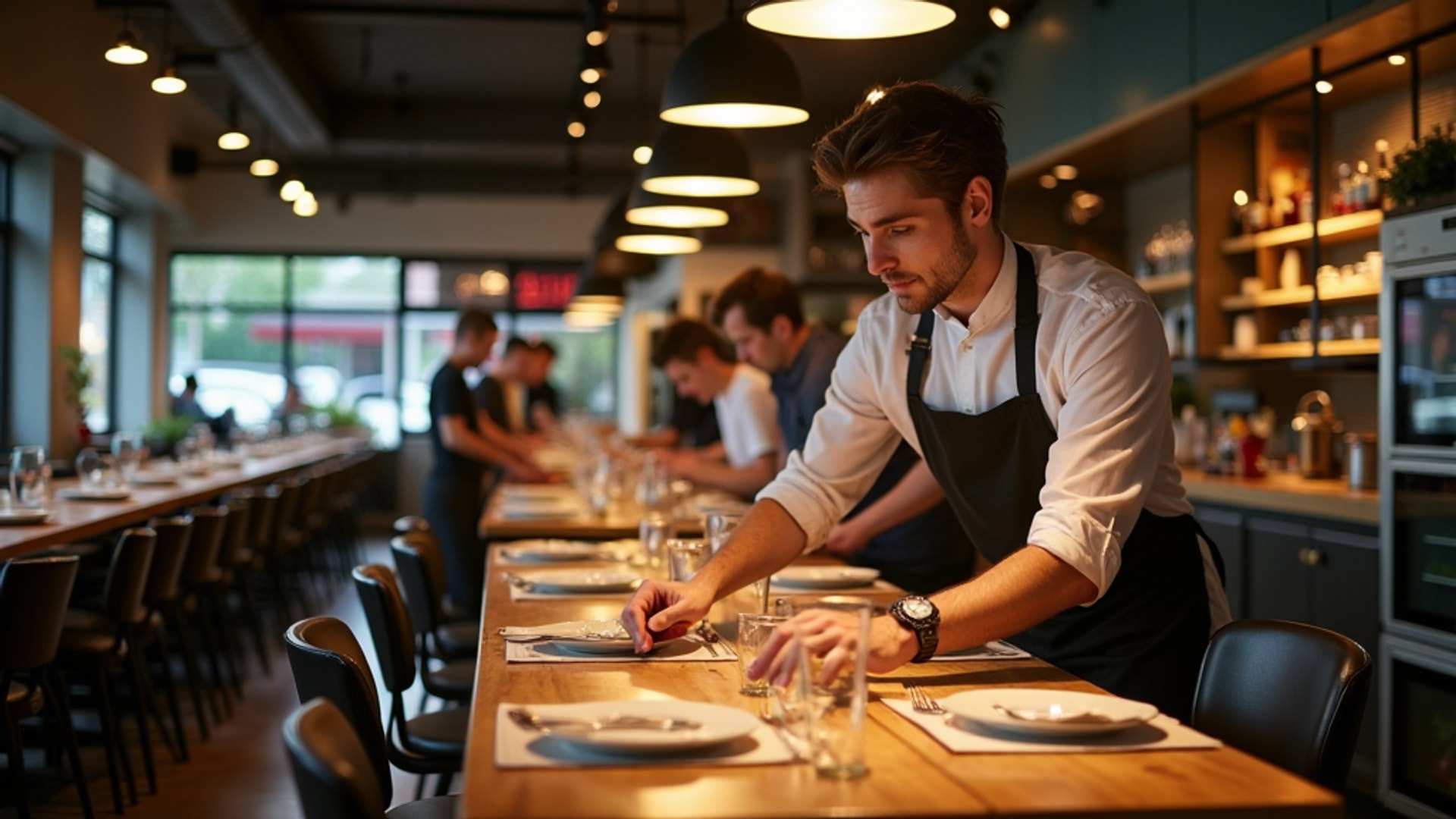
Front-of-house opening — station setup, table settings, restroom inspection, lighting and music confirmation, POS readiness verification, reservation review
Back-of-house opening — temperature logging for all refrigeration and hot-holding equipment, ingredient prep completion, equipment function verification, station organization, food safety checks including expiration date review
Manager opening — staffing level confirmation, supply level verification, reservation count review, daily goal communication to team, floor and kitchen walkthrough
These procedures need to be documented and practiced before opening day. Staff who are still learning the physical procedures of their jobs cannot simultaneously learn the opening protocols. Build the habit during training, not during service.
Building in Contingency
The most common mistake in restaurant opening timelines is building a plan with no float. Every phase has potential delay points: permit processing that takes three weeks longer than expected, equipment with extended lead times, a contractor who misses milestones, a key hire who takes longer to find.
The Fork CPAs recommend budgeting 10-20 percent of total startup costs as an emergency reserve. The equivalent for the timeline is building 2-4 weeks of buffer into each major phase transition — construction completion to pre-opening preparation, pre-opening to soft opening, soft opening to grand opening.
Operators who build buffer into their timeline open on schedule. Operators who build no buffer invariably open late — and pay rent for every week the delay extends.
→ Read more: Restaurant Buildout: Costs, Timeline, and Budget Planning
→ Read more: Restaurant Staffing Before Opening: Building Your Team from Scratch
The goal is not speed to opening. The goal is readiness on opening day.